The 4Ds of AI Fluency: Delegation, Description, Discernment and Diligence
When people compare AI models, they often talk about speed, intelligence or the size of the context window. The person working with the model also shapes the result.
When I completed the AI Fluency courses on Claude Academy, one idea stuck with me: AI fluency takes human judgment. This is where the 4Ds come in.
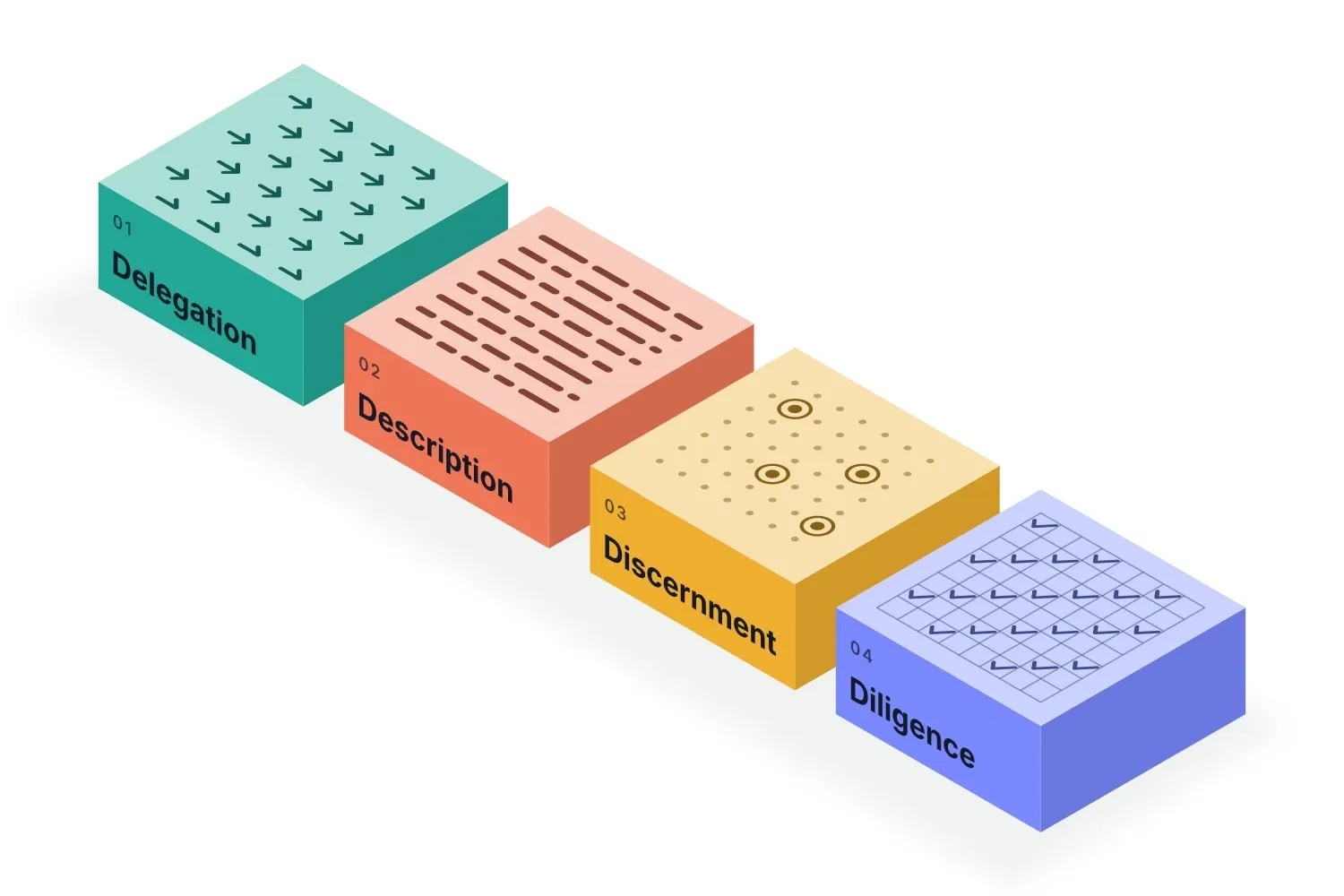
The 4D AI Fluency framework names four skills: Delegation, Description, Discernment and Diligence. They help you use AI effectively without wasting time or overlooking questions of ethics and safety.
Literacy and fluency
Literacy is knowing what something is. Fluency is being able to use it naturally, in context, with judgment.
You can understand how a large language model uses tokens and still hand it the wrong task. Knowing how much fits in its context window won’t tell you whether its answer is good enough to ship.
Fluency closes that gap. It moves the focus from “what can the tool do?” to “how do I work with it well?”
The framework distinguishes three ways to work with AI. With automation, you define a task and the system carries it out. Augmentation means thinking through a problem or creating something together. Agency gives the system room to act independently on your behalf.
The deeper the AI’s involvement, the more the 4Ds matter.
1. Delegation: deciding what to hand over
Delegation starts before you write a prompt.
Should AI be involved here at all? If so, which part? And which part stays with me?
Start with the problem: what are you trying to achieve, and what does “done” look like? Then consider the platform. Where does this system do good work, and where does it fall short? Keep the parts that need your judgment or context the model doesn’t have.
Sometimes I will ask AI for a draft. If I already have one, it may be more useful to ask it to challenge my thinking. Some work I will always keep for myself.
2. Description: communicating intent
Once you decide to work with AI, you have to explain what you want.
In a previous post I wrote about natural language becoming the new instruction layer. Description is the competency that makes that instruction layer work.
“Write me X” leaves the product open to interpretation. Say who will read it, what it should cover and which format and tone suit that audience. If the process matters, name the sources or the angle you want the model to take.
Performance is about how you want the model to work with you. If you want a brief critique, say so. If you want it to ask questions before it starts writing, tell it when to stop and ask. The model cannot read your mind. It can only work with what you give it. Vague intent produces vague output.
Description is where clarity of thought becomes visible. If you struggle to describe what you want, the problem is usually not the AI.
3. Discernment: evaluating what comes back
AI output often looks finished. It is fluent, confident and well-structured. That is exactly why it needs scrutiny.
Treat the product as a draft. Check the facts and ask whether it covers what your reader needs. Look at the process too: does the reasoning hold up or did the model fill a gap with a plausible guess (hallucination)?
To judge performance, consider the exchange itself. Did working this way help you or did you spend more time correcting the model than you saved?
What you notice in the output can help you describe the task more precisely or decide to take part of it back.
4. Diligence: taking responsibility
The first three Ds are about working with AI. The fourth is about owning the result.
Diligence starts during creation, when you choose which AI system to use and what to share with it. Transparency means telling the people who rely on your work what part AI played. At deployment, verify what you plan to publish or ship.
When something goes wrong, “the AI wrote it” is not an answer. The human who delegated, described, discerned and did the diligence is still the one responsible.
How the 4Ds form a loop
It is tempting to read the 4Ds as four steps in a row. In practice they form a cycle:
- Delegate a task and describe what you need.
- Review the result. If it falls short, refine your instructions or reconsider which parts to delegate.
- Use what you learned when you try again.
Diligence applies throughout. You still own the outcome if you change the instructions or take part of the task back.
Why this matters
The 4Ds apply across different models and interfaces. A more capable model gives you more work to choose from, including work you should keep. When you give a system room to act on its own, it needs to know what you want to achieve as well as which instructions to follow.
A convincing answer makes mistakes harder to spot. The more people rely on what you ship, the more those checks matter. Before you hand over the next task, decide where the model’s work should end and what you will check yourself.
Thank you for reading.
-Bruno

